
Investment banking is one of the most prestigious and financially rewarding careers in the United States. Professionals in this field work with corporations, governments, institutional investors, and private clients to raise capital, manage mergers and acquisitions, provide financial advisory services, and execute complex investment transactions. Because of the high level of responsibility and technical expertise involved, investment banking positions are among the highest-paying jobs in the financial industry and attract thousands of ambitious graduates each year.
The investment banking industry plays a critical role in the U.S. economy by helping companies secure funding, expand operations, acquire competitors, and enter public markets through Initial Public Offerings (IPOs). Investment bankers analyze financial data, evaluate business opportunities, prepare valuation models, negotiate transactions, and provide strategic recommendations that influence billion-dollar business decisions. Their expertise helps organizations achieve long-term financial growth while creating value for investors and shareholders.
Investment bankers work for global investment banks, commercial banks, boutique advisory firms, private equity firms, asset management companies, and financial consulting organizations. Some of the world’s largest financial institutions recruit talented professionals for investment banking divisions, offering competitive salaries, performance bonuses, international exposure, and significant career advancement opportunities. These firms seek candidates with strong analytical abilities, financial knowledge, communication skills, and leadership potential.
One of the biggest attractions of investment banking is the earning potential. Entry-level analysts often receive competitive base salaries along with annual performance bonuses. As professionals gain experience and move into associate, vice president, director, and managing director positions, total compensation can increase substantially through bonuses, profit sharing, and long-term incentive programs. Senior investment bankers who successfully manage high-value transactions often earn compensation packages that significantly exceed average corporate salaries.
The educational foundation for an investment banking career typically begins with a bachelor’s degree in finance, accounting, economics, business administration, mathematics, or a related field. Many leading investment banks recruit graduates from highly ranked universities, although candidates from other institutions can also succeed by demonstrating exceptional academic performance, leadership experience, internships, and technical financial skills. A strong understanding of corporate finance, accounting principles, statistics, and capital markets is essential for entering this competitive profession.

Many professionals enhance their qualifications by pursuing advanced education such as a Master of Business Administration (MBA) or specialized finance programs. An MBA from a respected business school can improve promotion opportunities and provide valuable networking connections within the financial industry. Additionally, certifications such as the Chartered Financial Analyst (CFA) designation are highly respected and demonstrate advanced expertise in investment analysis, portfolio management, and financial ethics.
Investment banking professionals require a combination of technical knowledge and interpersonal skills. Financial modeling, company valuation, accounting analysis, Excel proficiency, PowerPoint presentation development, and market research form the technical foundation of the job. Equally important are communication, negotiation, leadership, problem-solving, attention to detail, and the ability to work under pressure while managing multiple high-priority projects simultaneously.
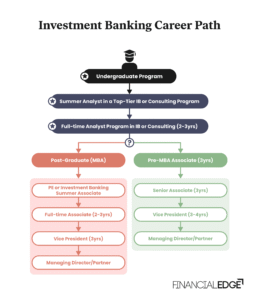
The typical investment banking career path begins as an Investment Banking Analyst. Analysts spend much of their time conducting financial research, preparing presentations, building valuation models, analyzing financial statements, and supporting senior bankers during client transactions. This role provides valuable exposure to corporate finance and serves as the entry point for long-term advancement within the industry.
After several years of successful performance, analysts may be promoted to Investment Banking Associate. Associates supervise junior analysts, manage client presentations, coordinate financial analysis, and play a larger role in transaction execution. Many associates enter investment banking after completing an MBA program, bringing additional management skills and business knowledge to the role.
The next stage typically involves promotion to Vice President (VP). Vice Presidents oversee transaction teams, maintain client relationships, negotiate deals, coordinate due diligence, and ensure projects remain on schedule. At this level, professionals begin taking greater responsibility for business development while balancing technical financial work with leadership responsibilities.
Experienced Vice Presidents may eventually advance to Director or Executive Director positions, where they focus heavily on client acquisition, strategic advisory services, and managing large transaction portfolios. Directors often supervise multiple deal teams simultaneously while maintaining relationships with corporate executives, institutional investors, legal advisors, and regulatory agencies involved in major financial transactions.
The highest leadership position within most investment banking divisions is Managing Director (MD). Managing Directors are responsible for generating business, building long-term client relationships, leading complex transactions, mentoring senior professionals, and driving revenue growth for the firm. Compensation at this level is often heavily performance-based and can include substantial annual bonuses linked to completed transactions and business development success.
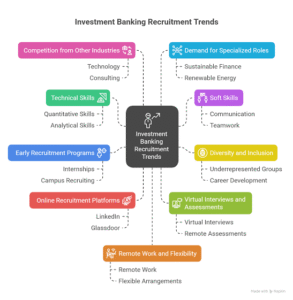
Internships play a crucial role in launching an investment banking career. Most major financial institutions recruit future analysts through highly competitive summer internship programs. These internships provide hands-on experience in financial analysis, valuation modeling, mergers and acquisitions, capital markets, and client services. Successful interns frequently receive full-time employment offers before completing their university degrees.
Networking is another critical component of investment banking recruitment. Students and early-career professionals often build relationships through university career centers, alumni associations, finance clubs, professional conferences, LinkedIn, and internship programs. Strong professional connections can increase interview opportunities and provide valuable industry insights during the recruitment process.
Technology continues transforming investment banking through artificial intelligence, machine learning, automation, financial analytics, and cloud-based collaboration platforms. Modern investment bankers increasingly use sophisticated software for financial modeling, market analysis, risk assessment, and transaction management. Professionals who combine strong financial expertise with technological proficiency are well-positioned for future career growth.
Despite its attractive compensation, investment banking is known for demanding work schedules and high-performance expectations. Professionals frequently manage tight deadlines, complex financial transactions, and significant client responsibilities. Time management, resilience, adaptability, and teamwork are essential for long-term success in this fast-paced industry.
The future outlook for investment banking in the United States remains strong as businesses continue seeking capital, pursuing acquisitions, expanding internationally, and adapting to evolving financial markets. Economic growth, technological innovation, renewable energy investments, healthcare expansion, and infrastructure development continue generating opportunities for investment banking professionals across numerous industries.
Beyond traditional investment banking roles, experienced professionals often transition into private equity, venture capital, hedge funds, corporate finance, consulting, fintech, wealth management, or executive leadership positions. The analytical skills, financial expertise, and strategic thinking developed in investment banking create numerous long-term career opportunities within the broader financial services sector.
For individuals seeking a challenging career with exceptional earning potential, global exposure, and continuous professional growth, investment banking remains one of the most respected professions in the United States. By earning a strong educational foundation, developing advanced financial skills, completing competitive internships, building professional networks, and continuously expanding industry knowledge, aspiring investment bankers can position themselves for long-term success in one of the world’s most dynamic and rewarding financial careers.